

Last updated: May 2026
TL;DR: Microsoft, Google, Meta, and Amazon are spending $725B on AI infrastructure that is already reshaping salary floors: entry-level tech postings are down 23% while AI-adjacent workers are seeing 15 to 20% salary premiums within 18 months of a role pivot. Identify which parts of your job involve information processing a model can now do, and start moving toward the work it cannot.
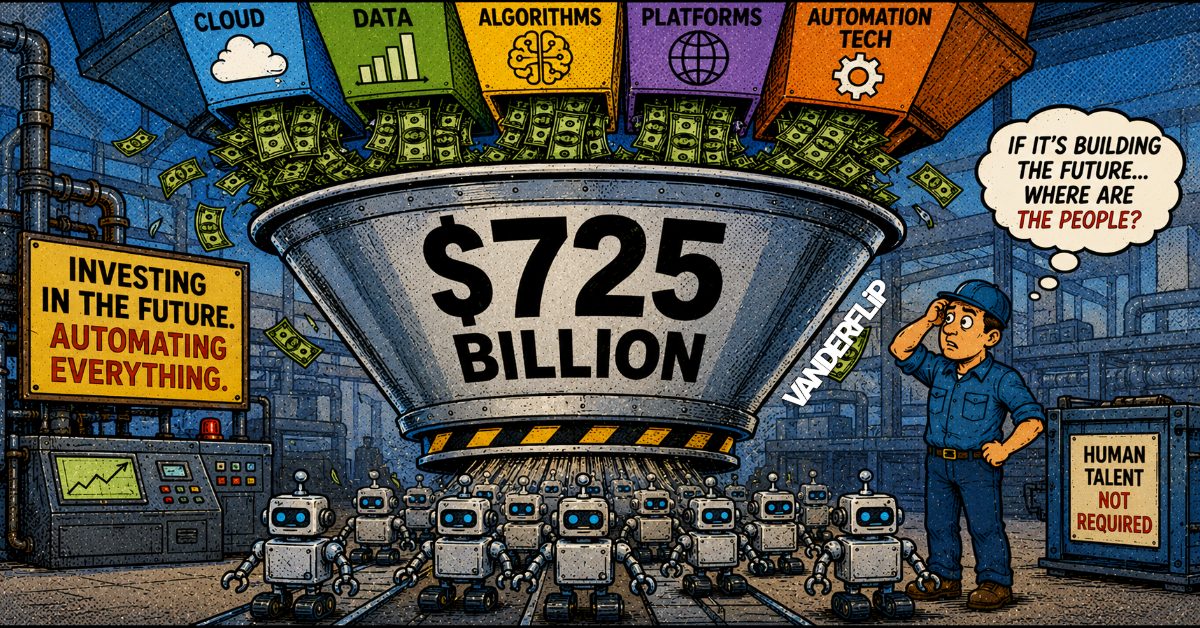
$725B is not an investment in a better future. It is Microsoft, Google, Meta, and Amazon building the infrastructure that determines whose skills stay valuable and whose do not. The people who understand what that money is actually buying are already repositioning. Everyone else is waiting for a press release to explain it to them.
Most takes on this number are wrong in both directions. The optimists say it proves AI creates jobs. The pessimists say it proves AI kills jobs. Both are missing the mechanism. What $725B in combined AI capex, drawn from 2025 and 2026 investor filings, actually buys is concentration. It moves the leverage from workers who produce information to the infrastructure that processes it. That is a different problem than either camp is describing.
The Bureau of Labor Statistics data makes the split visible. Entry-level tech postings dropped 23% while senior and specialist roles rose 12%. That is not a hiring slowdown. That is a reshaping of who gets hired and at what price. The middle of the salary curve is thinning. The top is getting paid more because there are fewer seats. The bottom is getting automated out of the entry point entirely.
The BCG 2026 Future of Work report puts a harder number on who bears the most risk: 79% of women versus 58% of men face automation risk in their current roles. That gap is not random. It maps onto occupational concentration in administrative, clerical, and data-processing work, the exact categories that $725B in AI infrastructure is designed to absorb. This is a structural issue, not a temporary disruption.
On the other side of that equation, LinkedIn Economic Graph data from May 2026 shows AI engineers earning roughly $28,000 more annually than traditional software engineers in equivalent roles. IBM Security 2025 found that workers who pivoted to AI-adjacent roles saw 15 to 20% salary premiums within 18 months. Prompt engineering roles now command six figures at major employers. AI infrastructure roles are growing 4.3 times faster than traditional software positions, according to Vanderflip’s ongoing AI labor market coverage.
None of this requires you to become an engineer. It requires you to understand which part of your current role involves information processing that a model can now do faster, and which part involves judgment, relationships, or original context that a model cannot replicate. That line is the only career question worth asking right now.
$725B does not buy everyone a raise. It buys four companies the ability to decide who needs one.
FREQUENTLY ASKED QUESTIONS
Which jobs are most at risk from the $725B AI investment?
BCG’s 2026 report identifies administrative, clerical, and data-processing roles as highest risk, with 79% of women and 58% of men in their current roles facing automation exposure. Entry-level information-processing jobs are the first to disappear.
How much more do AI engineers make compared to regular software engineers?
LinkedIn Economic Graph data from May 2026 shows AI engineers earning roughly $28,000 more annually than traditional software engineers in comparable roles.
How fast can I see a salary bump if I pivot to AI-related work?
IBM Security 2025 found that workers who moved into AI-adjacent roles saw salary premiums of 15 to 20% within 18 months of making the transition.