

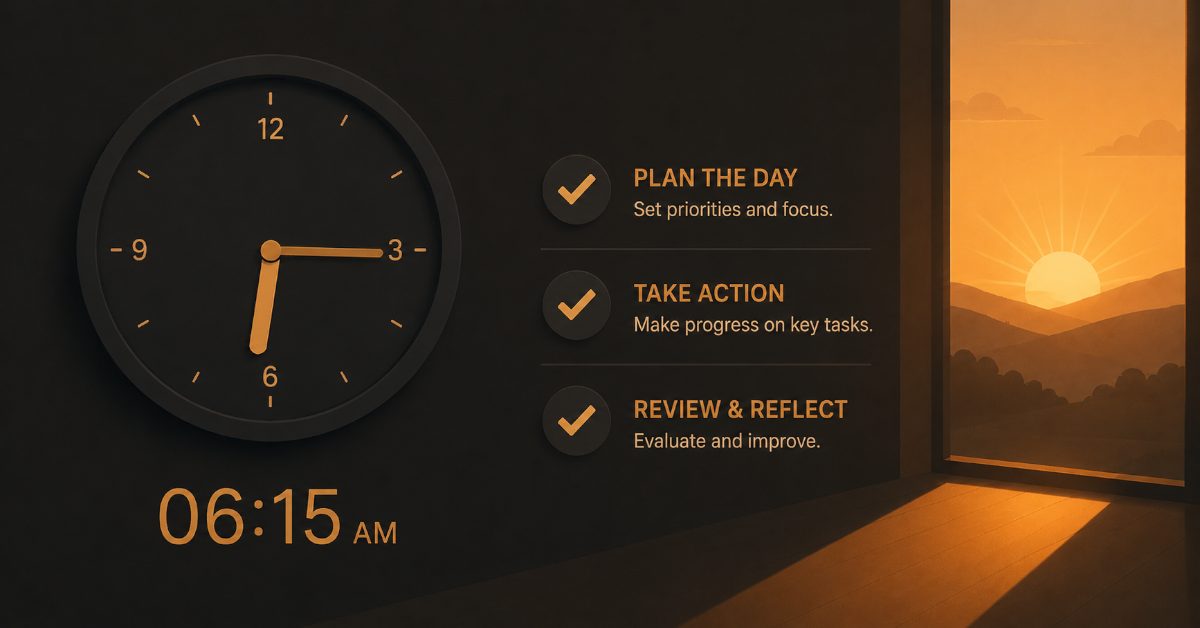
It’s Shorter Than You Think
You’ve seen the morning routine videos. Up at 5am, ice bath, meditation, journaling, a green smoothie, an hour of reading, a workout, all before the sun is fully up. They’re impressive. They’re also why your morning routine keeps failing.
The problem isn’t you. The problem is that elaborate routines require perfect conditions, and perfect conditions almost never exist. A bad night’s sleep, a sick kid, an early meeting, and the whole ninety minute cathedral collapses. Miss it twice and you quit. The routines that actually stick are the boring, short ones, and the behavioral science explains exactly why.
Why Long Routines Fail
Two things kill ambitious morning routines.
The first is that they depend on motivation and willpower, which are the least reliable fuels there are. They’re high some mornings and gone others, and a routine that needs you to feel inspired at 5am will fail every morning you don’t. Anything built on willpower is built on sand.
The second is the all or nothing trap. When a routine has eight steps and takes ninety minutes, missing it feels like total failure, and total failure makes you abandon the whole thing rather than do a smaller version. Behavioral researchers call the opposite approach habit stacking and starting small, and it works because it removes the two failure points: it asks almost nothing of your willpower, and it’s so short that you can do it even on a terrible day.
The 15 Minute, 3 Thing Routine
Here’s the version that survives contact with real life. Fifteen minutes. Three things. That’s the entire prescription, and the shortness is the feature, not a compromise.
Thing one: light and water, five minutes. The moment you’re up, get bright light on your face and drink a full glass of water. Open the curtains, step outside if you can, and rehydrate after eight hours without fluid. This isn’t a wellness flourish. Morning light sets your internal clock so you sleep better tonight, and water counters the mild dehydration that makes you feel foggy. Two tiny actions, real physiological payoff, almost zero willpower required.
Thing two: move your body, five minutes. Not a workout. Just movement. A short walk, a few stretches, ten pushups, anything that raises your heart rate slightly and tells your body the day has started. Five minutes is the floor, and the floor is the point, because five minutes is something you’ll actually do on the morning you slept badly. On good mornings it naturally stretches longer. On bad mornings you still hit it.
Thing three: set your one priority, five minutes. Before the phone, before the email, before the world starts making demands, decide the single most important thing you want to accomplish today. Write it down. One thing. This is the highest leverage five minutes in the routine, because it means you start the day pointed at what matters instead of reacting to whatever lands in your inbox first. Most people let the day choose their priorities. This step lets you choose them.
That’s it. Light and water, movement, one priority. Fifteen minutes, and every piece earns its place.
Why This One Sticks
Three reasons the short version outlasts the long one.
It’s anchored to something you already do. You already wake up, so the routine attaches to an existing, automatic event. You don’t have to remember to start it, because getting out of bed is the trigger. That’s habit stacking, and it’s how new behaviors get glued to old ones.
It’s small enough to survive a bad day. The entire point of fifteen minutes is that there’s no morning too rough to fit it in. Consistency beats intensity every single time when you’re building a habit, and a routine you do every day at 60 percent crushes a routine you do twice a week at 100 percent and then quit. The streak is the asset, and short routines protect the streak.
It scales when you want it to, without requiring it. Once the fifteen minute version is automatic, genuinely automatic, like brushing your teeth, you can add to it if you feel like it. Read for ten minutes, meditate, journal. But the core stays small and protected, so even when life blows up the additions, the foundation holds. You never lose the whole thing, because the whole thing was only ever fifteen minutes.
The Honest Takeaway
A morning routine isn’t a personality, a moral test, or a 5am sermon about discipline. It’s a small set of actions that point your day in the right direction, and the only one that helps is the one you actually do. Stop trying to build the ninety minute masterpiece. Build the fifteen minute version, do it every day including the bad ones, and let it grow on its own terms. Shorter is what makes it stick, and sticking is the whole game.